Structure-aware diagrams. Two ways to work, one consistent outcome.
StructureGram isn't just a diagramming tool — it's structure-aware modelling software that checks each relationship against Australian entity rules as you add it, and lays every diagram out consistently.
Create diagrams your way
StructureGram lets you work in the way that feels natural — without sacrificing structure, consistency, or correctness.
- Visual-first: draw entities and relationships on a canvas
- Data-first: define entities and relationships directly
Either way, StructureGram turns your input into a structured model, checked as you go, that produces consistent diagrams every time.

Drawing is just an interface. Structure is the system.
In most tools, drawing is the system. In StructureGram, drawing is just one way to define the underlying structure. When you draw in StructureGram:
- Entities are formally created, not just shapes
- Relationships are defined explicitly, not just lines
- The diagram becomes a structured model, not a static picture
That is why your diagrams stay clean, consistent, and easy to update.
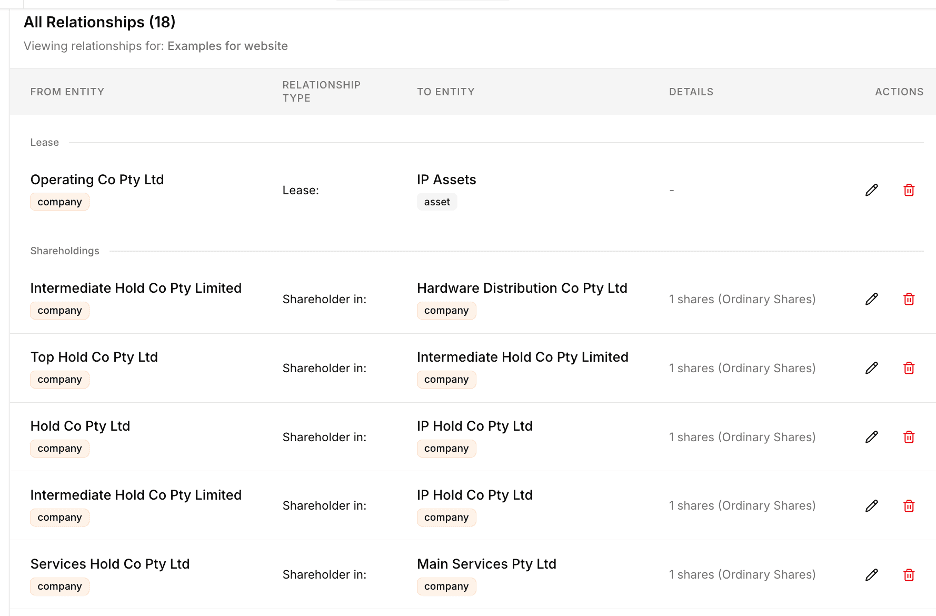
Built-in rules, checked as you add relationships
StructureGram checks each relationship against domain-specific rules like these as you add it.
Entity and asset structure
Entity ownership
- A company cannot hold shares in its own shareholder, or its own shares through a trust
- Share classes with capital, dividend and voting rights
- Third-party shareholders tracked alongside managed entities
- Intra-group and inter-group entity relationships mapped end-to-end
Assets
- Comprehensive asset types — property, financial assets, vehicles, equipment and more
- Ownership methods: sole, joint tenants and tenants-in-common
- Asset values with associated liabilities
- Security interests and encumbrances over assets
- Lease tracking linked to underlying assets
Trust rules
- Valid trustee entity types checked
- Beneficiary, appointor and trustee roles tracked
- Third-party unit holders recorded alongside managed entities
- Fixed unit trusts and hybrid trust structures supported
Compliance and relationships
SMSF compliance
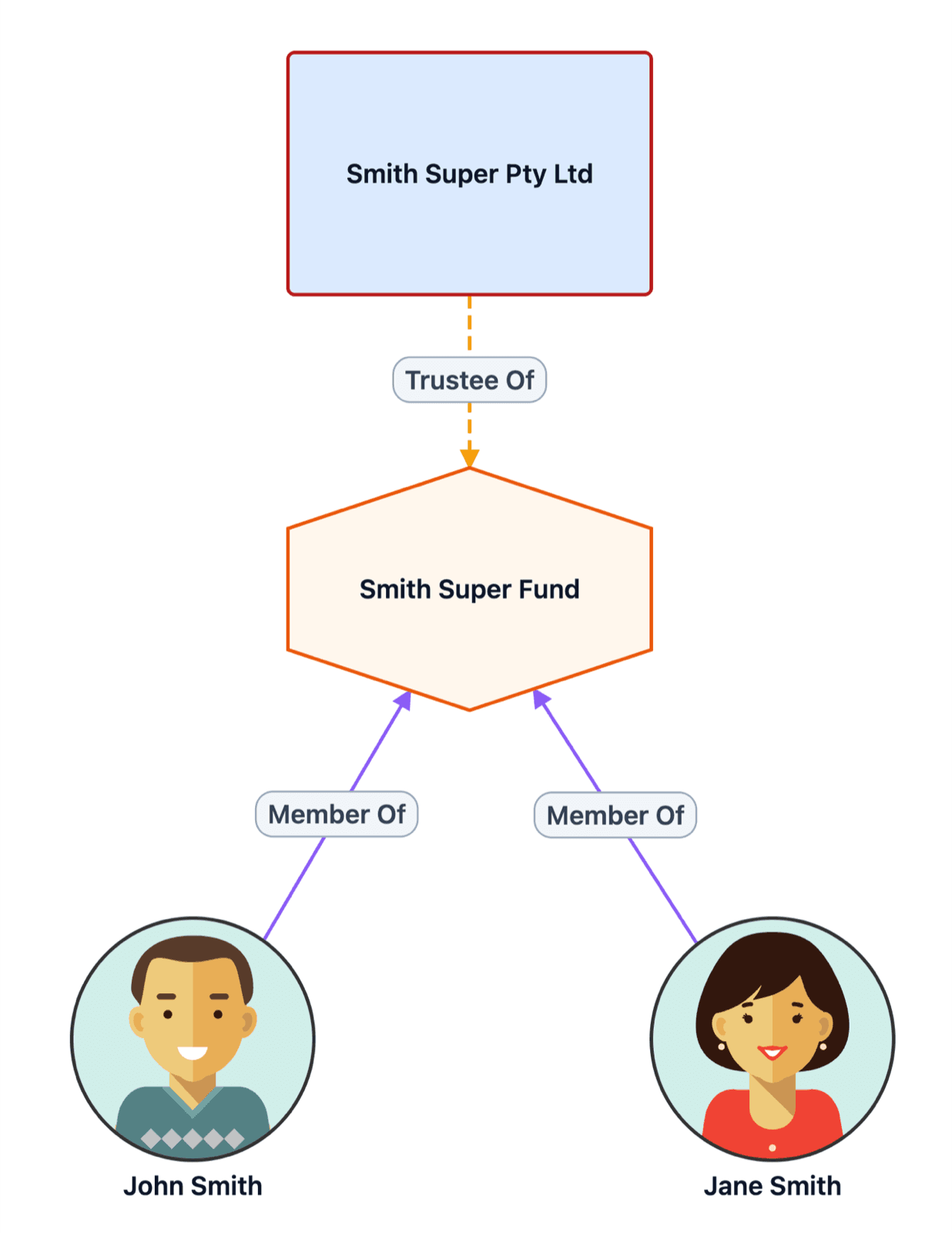
- Maximum of 6 members
- Members must be individuals
- No fewer than two individual trustees required
- Cannot mix corporate and individual trustees
Family relationships
- Each spouse and parent link stored once, read from both people
- Married, de facto and separated statuses tracked
- Parent–child hierarchy maintained consistently
- Biological, adopted, foster and step children supported
Partnership rules
- Partner percentages cannot exceed 100 %
- Valid partnership entity types checked
Data and financial integrity
Data integrity
- Duplicate entities detected
- Only valid relationships offered as options
- Cascade deletion removes redundant relationships automatically
- Start and end dates tracked per entity and relationship for group snapshots
Financial relationships
- Inter-entity loans with terms and conditions
- Security tracking — mortgages and PPSR security interests
- Guarantor relationships between entities
- Lease tracking with linked asset identification
Distributions
- Distribution dates required
- Valid distributor–recipient relationship required
- Multiple distributions within a financial year tracked
Two approaches to diagramming
Traditional diagram tools let you draw anything, including invalid structures. StructureGram checks what you draw against the rules as you add it.
Traditional tools
- Free-form drawing
- Rules checked by hand
- Depends on the visual skill of whoever draws
- Easy to get wrong
- Static pictures
- Generic shapes and lines
- No validation
- Consistency depends on the user
StructureGram
- Structured modelling
- Rules built in
- Clarity driven by the system
- Common mistakes caught as you work
- Living structures
- Entities that understand their domain
- Rules checked as you add relationships
- Consistency built in
Consistency, regardless of experience
Because the rules are built in and the layout is automatic, everyone produces consistent diagrams, whatever their experience or visual skill.
Junior staff, senior standards
New team members create diagrams that match firm standards from day one.
Firm-wide conventions
Firm-wide styles applied for every user.
Immediate recognition
Diagrams are immediately recognisable and readable by anyone in the firm.
Risk reduction
Built-in compliance guardrails reduce the risk of invalid structures.
Audit-ready output
Clear, consistent diagrams ready for client files and audit.
Time savings
Less time spent checking relationships by hand.
Not just a drawing tool
StructureGram isn’t a generic diagramming tool. It is structure-aware modelling software for real-world relationships.
- Not a generic drawing tool (Visio, Lucidchart, Miro)
- Not a generic org chart tool (Lucidchart, OrgChart)
- Not a generic modelling tool (Dia, draw.io)
It is purpose-built for Australian entity types: a structured data system with diagram visualisation.
Ready to see the difference?
Get started for free and experience structure-aware modelling first-hand.